Pulse Wave Model Calibration
We have developed novel, physics-based methods for calibrating pulse wave models, grounded in a comprehensive understanding of the haemodynamic mechanisms underlying pulse wave signals. These methods can be categorised into two main groups: (i) calibration of patient-specific 1-D/0-D blood flow models and (ii) calibration of population-specific pulse wave datasets across thousands of virtual subjects.
Key contributions to patient-specific calibration of 1-D/0-D blood flow models include:



- A methodology to reduce the number of arterial segments (and hence input parameters) required to accuretly simulate blood pressure and flow waveforms at arbitrary sites within a given arterial network, using nonlinear 1-D modelling (J R Soc Interface, 2018, Am J Physiol, 2015);
- Physics-based methods for estimating mechanical properties of the arterial wall (J Eng Math, 2012);
- Calibration of 0-D outflow Windkessel models from data that can be measured in vivo (Heliyon, 2024; J R Soc Interface, 2016; Int J Numer Meth Biomed Engng, 2014; Commun Comput Phys, 2008).
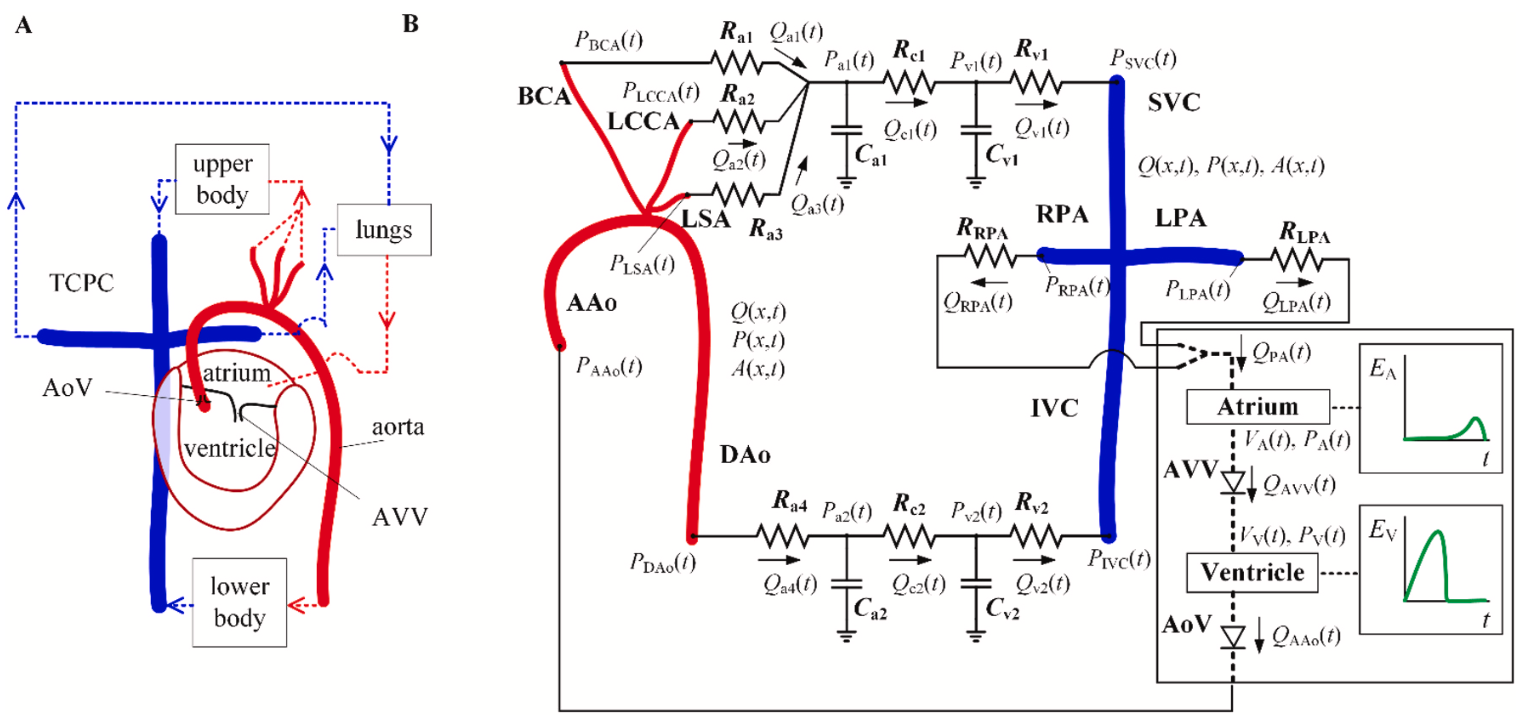
- Calibration of elastance-based 0-D heart models within a closed-loop 1-D/0-D framework using in vivo measurable data (Heliyon, 2024). This approach employs a stepwise, physics-based methodology involving simpler open-loop models, which also facilitates the calibration of 0-D Windkessel models and 1-D arterial wall properties.

Funders